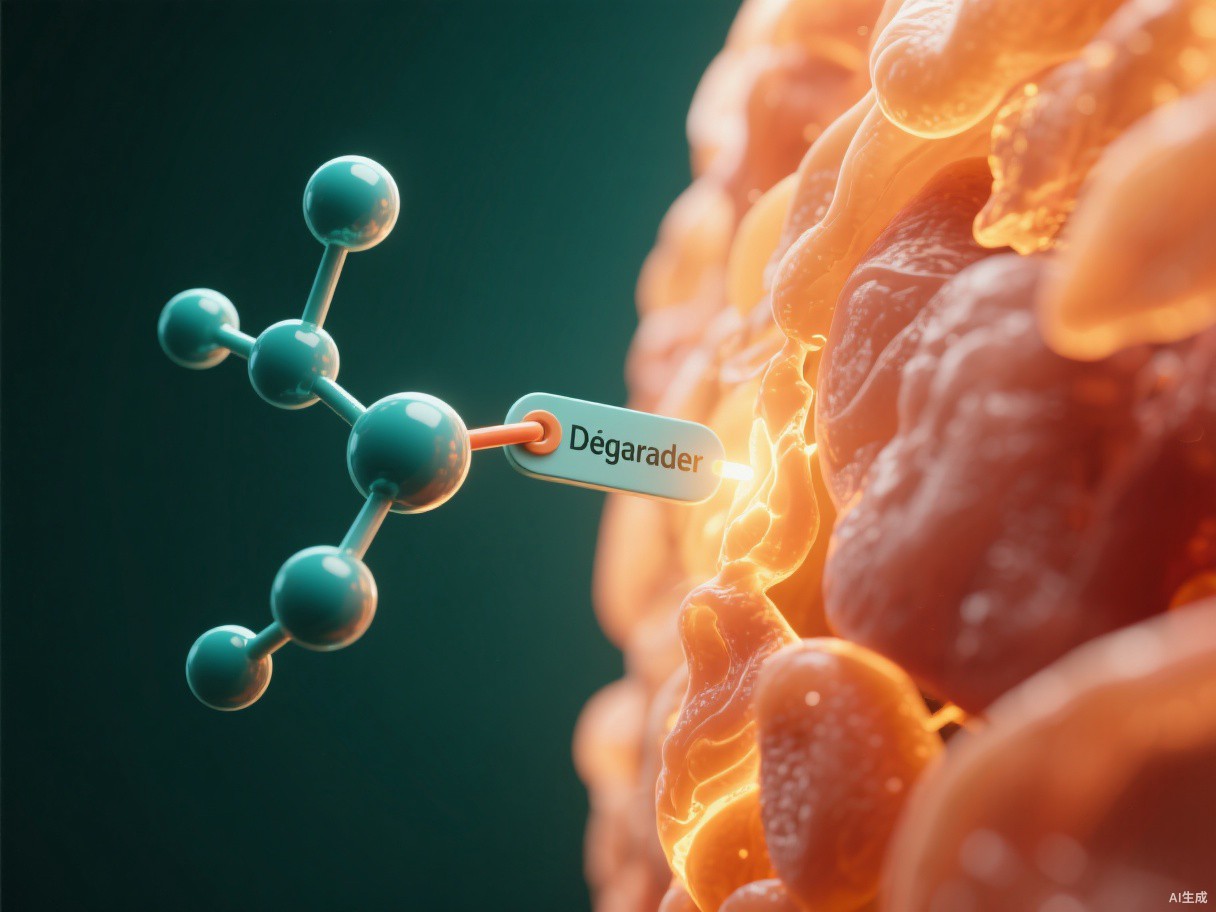
A comprehensive database of Hydrophobic Tagging Degraders — search by keyword, SMILES, hydrophobic tag, or degradation pathway
Curated hydrophobic tagging degraders: name, molecular structure, POI, degradation pathway, representative activity, hydrophobic tag type, and reference. Scroll sideways for more, or open the Browse page for full filtering.
Yearly output of hydrophobic tagging degrader papers. Papers are grouped by publication year and de-duplicated by DOI — a paper reporting several degraders is counted once, and the tallest bar is the most productive year.
Fulvestrant is considered an important source of inspiration for hydrophobic tagging-mediated protein degradation strategies. Studies have shown that, upon binding to the estrogen receptor, fulvestrant induces conformational changes in the receptor ligand-binding domain, thereby exposing previously buried hydrophobic regions on the protein surface; this increases the surface hydrophobicity of the receptor and reduces its stability, ultimately promoting receptor degradation.
10.1016/j.molcel.2005.04.014In 2011, Neklesa et al. proposed a hydrophobic tagging (HyT)-mediated strategy for targeted protein degradation. The core concept of this strategy is to introduce an artificial hydrophobic moiety onto the surface of a target protein via a small molecule, thereby mimicking the aberrant hydrophobic exposure associated with partial protein denaturation; this induces recognition of the target protein by the cellular protein quality control system and promotes its degradation via the proteasome pathway. To test this hypothesis, the researchers used a HaloTag fusion protein system to design and synthesize a series of bifunctional small molecules composed of a HaloTag-binding moiety and a hydrophobic moiety. Among these, HyT13, which contains an adamantane hydrophobic tag, effectively induced the degradation of HaloTag fusion proteins, and this degradation was blocked by proteasome inhibitors. This study provided the first experimental validation of the feasibility of achieving targeted protein degradation by artificially increasing protein surface hydrophobicity, thereby laying the foundation for the development of hydrophobic tagging technology.
10.1038/nchembio.597Although early hydrophobic tagging technology successfully achieved targeted degradation of HaloTag fusion proteins, its application relied on fusion expression of the target protein with HaloTag, which limited its ability to directly modulate endogenous proteins. To overcome this limitation, in 2014, Xie et al. extended the adamantane-based hydrophobic tagging strategy to endogenous proteins and developed TX2-121-1, a bifunctional small-molecule degrader targeting human epidermal growth factor receptor 3 (HER3). This study demonstrated that the hydrophobic tagging strategy can directly degrade endogenous proteins via target-specific ligands without relying on the HaloTag fusion system, representing an important step in the transition of HyT technology from tool compounds to small-molecule drugs.
10.1038/nchembio.1658Latest publications and research progress on hydrophobic tagging degraders. Click a card to read the full story.
A tert-butyl(diphenyl)silane hydrophobic tag conjugated to a gefitinib warhead induced dose-dependent degradation of mutant EGFR via the ubiquitin–proteasome pathway.
Read more →The first release integrates molecular structures, warhead–linker–tag decomposition, degradation activity, PK profiles and disease associations, with structure search and bulk download.
Read more →Cholesterol-derived hydrophobic tags conjugated to kinase inhibitors demonstrated efficient BRAF degradation through the autophagy–lysosome pathway.
Read more →HyTdb is an open knowledge base for targeted protein degradation (TPD) research, focused on degraders built on the hydrophobic tagging (HyT) strategy. The database integrates each molecule's original structure (warhead), linker, hydrophobic tag type, protein of interest (POI), degradation activity, degradation pathway, pharmacokinetics (PK), and disease information, and provides structure search, similarity search, and data download to support degrader design and mechanism studies.